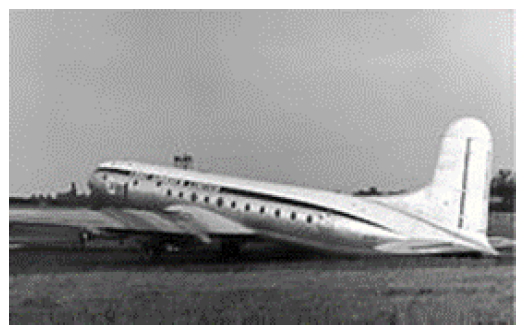
Llandow Air Disaster 12 March 1950


In the years after WWII there was a surge in demand for air travel. This was largely met with aircraft that had been sold off as surplus to requirements.

People began to realise that travel by aeroplane was something available to everyone, not just the rich.

A Cardiff entrepreneur chartered an aeroplane to fly from Landow airfield to Dublin for £10. Llandow was not a commercial airfield, though still operating for military use.

The Welsh team was on the brink of its first Triple Crown for nearly 20 years. Victories over England and Scotland set up a deciding match with Ireland. Thousands of supporters made the trip

The Saturday flight to Dublin on Saturday 11th was uneventful.  Wales won 6-3. Great! The boys celebrated until late.

Friends and families waiting to welcome fans home spotted the aircraft in the west. As the aircraft approached it seemed to be flying too low. Then with its undercarriage down the engines suddenly boosted causing the aircraft to stall and drop to the ground. 80 died with 3 survivors.

After a court of enquiry the Ministry of Civil Aviation announced that the probable cause of the accident was the luggage loading of the aircraft, which had moved the centre of gravity.

Whether or not luggage contributed to the crash, the weighing of luggage to this day stems from the crash. Rhoose Airport was created later, with a memorial stone in Sigginstone.

The death of the last survivor of 3 was reported in WalesOnline, May 2011.

BD

(A memorial plaque is erected in Siginstone on the road side near Park Farm, the site of the crash.)


Dewberrys Discovered


A stroll along the new cycleway and footpath on Port Road between Wenvoe and the Alps roundabout revealed some interesting plants lurking at the base of the hedgerow. Most surprising because it has not been recorded yet in the parish is Dewberry. Similar to the Blackberry but with some clear distinguishing features. The berries have a bluish waxy bloom to them and there are far fewer segments per fruit, a bit like a raspberry in this respect. The leaves are closer together than is the case with brambles and they tend to creep along the ground rather than throw up long prickly stems. They are known on Gower as 'monkey grabbers' as their low creeping habit means they are easier to miss until they have snared you around the ankles. On Gower and other dune systems you will often see people gathering the berries which some adore but others find bland and insipid. In Wiltshire it is known as the Token Blackberry. The leaves can also be used to make a tea


September Activities


Work in September included dead heading the roses at the community centre and on the village green and making a start on clearing overgrown shrubs on the latter. This will be finished this month. As I write this piece there is still plenty of colour in the remains of the summer bedding. Tulip and daffodil bulbs have been ordered ready to be planted in the window boxes and elsewhere at the community centre. October’s meetings will be on the 16th and 30th, weather permitting.

Work in September included dead heading the roses at the community centre and on the village green and making a start on clearing overgrown shrubs on the latter. This will be finished this month. As I write this piece there is still plenty of colour in the remains of the summer bedding. Tulip and daffodil bulbs have been ordered ready to be planted in the window boxes and elsewhere at the community centre. October’s meetings will be on the 16th and 30th, weather permitting.


September Walks


Black Hill Ridge – It was a long drive to the beginning of the walk, the final stretch following winding lanes until we reached the car park at the foot of Black Hill. In the north east of the Black mountains we were in Herefordshire north east of Llanveynoe and Longtown. Little Black Hill was visible to the south and our destination, Black Hill, rose steeply behind us.

Over a stile and we were travelling north along the valley and past Craswall. There was lots of mud but the ground remained mostly firm underfoot. The path was level or downhill so that the ridge we were to walk loomed higher and higher above us.

From the bottom of the valley, in woodland and to our right we could hear hounds baying. After a while the sound came from ahead of us – we guessed in the woodland as there were fields of sheep and cows. Then a large dog came bounding along the trail towards us and up the hill not even glancing at us it was so focussed on its quarry. A second hound followed soon after. Baying sounds could now be heard in several different directions. Passing through a gate we suddenly found ourselves surrounded by the pack, racing backwards and forwards and jumping a barbed wire fence in their quest. They totally ignored us apart from a few who gave us a brief sniff.

Having walked a few miles along the valley we took a path in a north westerly direction. We came onto open land which gradually sloped towards the lower slopes of Hay Bluff and we espied a hang glider. As it was 1pm, we stopped briefly in warming sunshine to eat our 1st lunch of the day (enough to get us to the top of the hill). Extensive views to the northeast spread out before us.

We used part of the Offa’s dyke path to climb Hay Bluff, an excellent path reinforced all the way to the ridge. Here we met our first walkers of the day, a group of girls doing their silver Duke of Edinburgh award.

Ignoring the trig point at the top of Hay Bluff we turned left (south east) to climb to the top of the ridge. Now we could enjoy our 2nd lunch, making our way to a small promontory we settled down. Fabulous views again, this time of the surrounding ridges and Pen y Fan could be seen in the distance. The Olchon valley lay below us.

Refreshed we continued along the top of the ridge; it is peat bog with many acrid pools and a paved pathway had been laid to preserve the habitat – very easy walking thanks to a lot of hard work and investment. As we continued we had to be careful to move left across the moorland and back to the Black Hill ridge as the solid path that is Offa’s Dyke could easily have taken us in the wrong direction. This was the only really rough ground of the whole day.

On reaching the Black Hill ridge our view was mainly the cultivated farmland to the east and the ridge rising above us to the west. One of the hang gliders came in to land on the lower slopes of Hay Bluff and another came very close to us as he veered around, to join his colleague.

As we progressed the ridge looked dauntingly narrow but once we arrived on its craggy section we realised it was at least 3ft wide along its length with a few large rocks to scramble over. Even vertigo sufferers were reassured. We could see the Olchon valley again and the ridge which Offa’s Dyke follows continuing for some miles across the valley.

At the end of the ridge the path went into a steep descent but in places there were steps worn into the hillside which made progress easier. Over the stile (the only one on this walk) which we crossed at the start of our walk and we were back at the car. 8¾ miles walked and 1200ft climbed and we all agreed that it had been fabulous



The Year of the Runaways

The Year of the Runaways
by Sanjeev Sahota

This Booker-short listed novel traces the lives of three Indian immigrants over a year.

The three young men, Tarlochan Kumar (Tochi), Avtar Nijjar and Randeep Sanghera, move into a house in Sheffield which is shared by numerous migrant workers. The fourth character in this story, Narinder Kaur, is a young British-raised devout Sikh girl, the visa-wife of Randeep, who moves separately into a flat in Sheffield. The author tells the story of each character’s past in India, the events that bring them to this country as immigrants and the struggle they then face in the daily fight for work, money and survival in England, as their lives become entwined.

The majority of the group agreed that the book is superbly written, simply expressed and a real page turner. It is thought provoking with clearly drawn characters and incidences. We are given good insights to Indian culture and the Sikh religion. Although the story-lines were tragic and moving at time, harsh details were not unduly dwelled upon. Unusually, the view was expressed that this is a book people need to read as it opens our eyes to a greater understanding of why people want to come to our country as immigrants.

One member of our group listened to this novel on Audio and expressed her delight at the way in which the background sounds really enriched the story and helped bring the culture alive.

However not all opinions were positive and a view that the book was depressing with continual hardships was also expressed. Additionally, it was agreed that a Glossary would be useful as the author has included many foreign words and phrases which were a bit daunting a times.

After a lively discussion the overall score was a positive 8 out of 10 and therefore a highly recommend.

The evening was pleasantly rounded off as we enjoyed tea, coffee and delicious snacks and cakes courtesy of Val.


What To Do In Autumn


The Village Show on 9th sept was a great advertisement for village life. A big thank you to the scouts for putting on a great day. I now know from personal experience what it takes to compete with the likes of Annie Bennett, Gordon Jones and the colossus that is Phil Morant. I spoke to a lot of people who wished they had entered in more categories plus others who hadn't entered this year but wished they had. So next year it could be standing room only. Let’s hope so and let’s give the organisers our support. One thing that I still cannot fathom is the outcome of my Tesco potatoes entry. Three specimens – all of them nearly exactly the same size – came nowhere. I believe I was robbed and the judges didn't even wear masks. Not that I'm bitter or anything.

All plants given to the environment group have now been planted on the village green so thanks to all who donated. Most of the gaps have now been filled. When travelling around the village it is good to see the effort that a lot of villagers make to keep Wenvoe clean and tidy.

This year seems to have been particularly bad for a lot of lawns, especially on slopes. I believe the wet summer has had a detrimental effect by washing any goodness out the soil. Having spoken to green keepers and trawled google for advice to share, the consensus is that lime is the answer and should be applied in the Autumn on a dry but not frosty day. The lawn will then have all winter to absorb the lime. Dealing with moss in lawns is time consuming and, if you get a contractor in, very expensive. While looking for moss killer at garden centres I came across a lawn treatment that claims you don't have to rake out the moss after treatment. It’s called Mo Bacter and was trialled on BBCs Beechgrove Garden series with outstanding reviews. They have it at the local garden centre. I don't know how good it is but I will be giving it a try in the Spring after liming. If your planning on laying new turf the Royal Horticultural Society reckon now is a good time and they should know.

Things to get done in October. Gardening at this time can seem like a lot of effort for little return, but work done now is well worth it such as clearing borders, cutting back and planting for next year with cheap perennials from garden centres. I have picked up really good plants at this time of year, a lot of which can be split, giving you multiple plants. October advice from the Eden Project Cornwall includes the following. 1. Divide herbaceous perennials. 2. Plant out spring flowers such as wallflowers. 3. Plant prepared hyacinths in vases for scent and colour in the house. 4. This is the time of year to cover up your garden furniture and clean out greenhouses, ponds and water butts.

On the veg patch, now is the time to divide established rhubarb crowns to create new plants. Planting out spring cabbage is another job to be done now. Tip from Jeff Dowling at the allotment. If you're going to use farmyard or horse manure, get it

quite fresh and cover it with a sheet till it rots down so that the goodness is kept in. Well rotted manure that has been left to the elements will have had all nutrients washed out of it before you use it.

I hope that you are enjoying the produce at this time of year. There is nothing quite like eating fruit and veg in season, whether it's consumed fresh or made into jams, pickles, tarts and wine. Don't forget to plant garlic now, pointy end up. Quite apt really with Halloween imminent.

Happy gardening.


A New Arbour

We have erected an arbour in the Elizabethan Orchard – see photo – and will be planting Honeysuckle to grow up the sides. Shakespeare often refers to Woodbine which some believe is Honeysuckle but he also refers to Woodbine entwined with Honeysuckle which suggests it may be something else. It is disappointing to have to report that one of the newly planted heritage Gooseberry varieties we planted has been stolen. Increased use of CCTV and distribution of our wildlife cameras may provide evidence that the police can make use of. We shall also be planting 20 bulbs of Spiked Star of Bethlehem which is the flower featured on our logo as the parish has the only confirmed and established site for this in Wales, where it has been growing for at least 20 years and probably longer. We have had printed our own T Shirts, thanks to Linda Evans, which you will see being worn by members when working in the orchards and nature reserves. This features the logo front and back. Our next major project will be the planting of the orchard at Goldsland Farm which will consist mainly of apples, including some cider varieties and perry pears


Dyffryn House


Dyffryn House is the Victorian mansion house within the Edwardian listed gardens in St Nicholas. It is currently managed by the National Trust on a 50 year lease. The House Steward and research teams are always looking for information on the history of the site. The original collection owned by the Cory family was sold at auction in 1937. If any local people are aware of any pieces that were sold locally we would love to hear from you.

We would also be very interested to talk to anyone who has memories of working at the site from the 1980’s and before- with the option to carry out an oral history.

Please contact Christina at Christina.Hanley@ nationaltrust.org.uk or 07483926208.


Back In School


It has hard to believe that we have already been back in school for 3 weeks!

Our new children are settling in beautifully into Nursery and Reception and we have also welcomed new families into our school community.

We were very pleased indeed with our ESTYN and Church School reports and the way in which the hard work, dedication and commitment of all stakeholders was recognised; the ethos of our school and the care and nurture provided to our pupils was recognised as being excellent.

We are looking forward to another school year, with lots of fun and exciting times ahead.


1 2